Talk2CAD › Joiners and cabinetmakers
Talk2CAD for Joinery
The jig that hits your hole pattern exactly. Not the one from the catalogue.
The kitchen is in, the door hangs crooked, and the jig in your case has the wrong centre distance. At the fittings supplier that means three weeks lead time for a plastic part. Describe it in one sentence instead, set the dimensions and let the printer run overnight.
Six parts you cannot buy like that.
Cup diameter 35 mm, centre distance 45 or 52 mm, stop against the door edge. All three are sliders, not a new model.
32 mm grid, 37 mm edge distance, length to match your side panel.
Hole spacings of 96, 128 and 160 mm on one part – with a stop for the front so nothing slips.
From your sander's port to the 35 mm hose. You measure both diameters and type them in.
Measure one, rebuild it, print twenty – instead of ordering a set that does not contain the one you need.
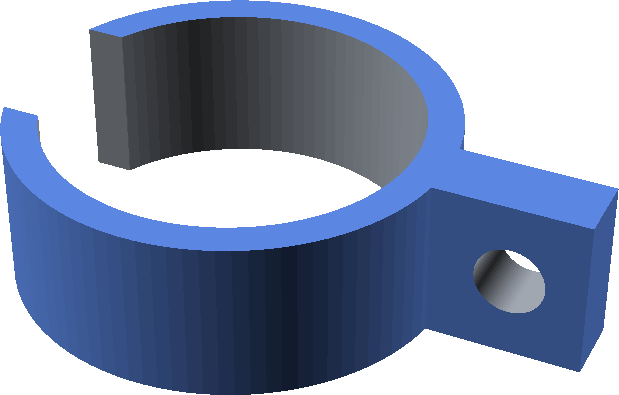
Radius freely selectable, mount to match your base plate.
Free as an STL. Dimensions adjustable right on the model – no account.
What a printed part can do – and what it cannot.
What has to carry load does not get printed: connectors under permanent load, drawer runners, fittings that a door hangs from. Templates, jigs, adapters, covers and spare clips are exactly the right case. And a drilling jig needs steel bushings – otherwise the bit eats the plastic dimension away after ten holes.
PLA is fine for templates that stay in the workshop. Anything that lives in the van should be PETG: PLA already warps behind the windscreen in summer at around 55 °C.
No. You describe the part in plain words – "drilling jig for concealed hinges, 35 mm cup, 45 mm centre distance, 3 mm stop" – and get a print-ready file. You then change the dimensions with sliders.
Every model is re-measured after it is built. If a dimension deviates from your figure by more than 0.5 mm, it is corrected. What your printer makes of it after that depends on its calibration.
STL for the slicer, STEP for your CAD, DXF for cutting, and the source code of the model. All four at no extra cost.
Describe your part. 50 generations on the house – and you see up front what comes after that.
Also for your trade: