No account. You get the file straight away.
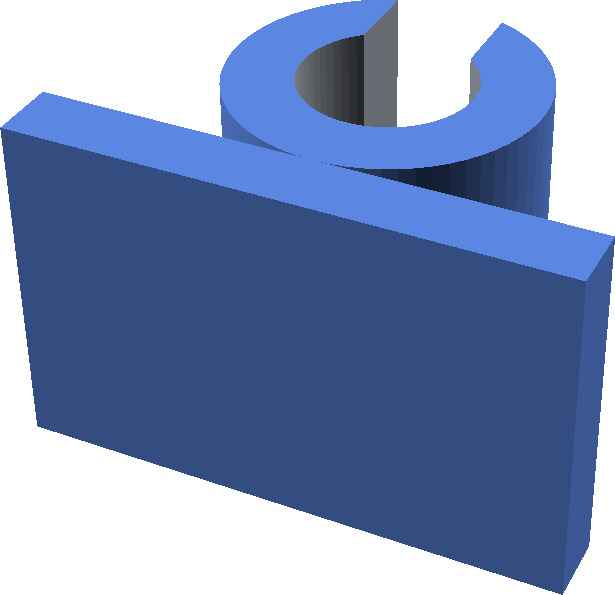
Hält ein 5-mm-Kabel an Tisch oder Wand. Rückseite plan für doppelseitiges Klebeband, Schlitz oben zum Einclipsen, ohne den Stecker abzuziehen.
// Kabelclip mit ebener Rückseite zum Aufkleben.
d_kabel = 5; // Kabeldurchmesser (mm)
breite = 10; // Breite des Clips (mm)
wand = 2; // Wandstärke (mm)
oeffnung = 3.2; // Spaltbreite zum Einclipsen (mm) [1:d_kabel+wand]
platte_h = 2; // Dicke der Klebefläche (mm)
platte_b = 16; // Breite der Klebefläche (mm)
$fn = 64;
e = 0.01;
r_aussen = d_kabel/2 + wand;
union() {
difference() {
cylinder(h = breite, r = r_aussen);
translate([0,0,-e]) cylinder(h = breite + 2*e, d = d_kabel);
// Einclips-Schlitz nach oben
translate([-oeffnung/2, 0, -e]) cube([oeffnung, r_aussen + 1, breite + 2*e]);
}
// Klebefläche unten, plan
translate([-platte_b/2, -r_aussen - platte_h, 0])
cube([platte_b, platte_h + e, breite]);
}
This is exactly the source behind the sliders above – the parameters are the named variables in it. You can open it locally in OpenSCAD and keep writing; you are not tied to anything. Download the SCAD – no account.
Made with Talk2CAD · exportable as STL, STEP, SCAD or DXF · keep building in the editor
Need something else? Describe your part – no account